
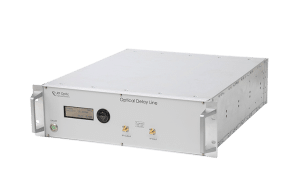
Optical Delay Lines

Optical Delay Lines
ODL and Altimeter ODL

ODL and Altimeter ODL

We offer two types of Optical Delay Lines: General Optical Delay Lines and Altimeter Optical Delay Lines (ALT ODL).

ODL Solutions

Our high-performance solutions for testing and calibrating of radar systems or for RF communications. The series consists of low-frequency models covering 1MHz to 6GHz which address the L, S, and C bands and high-frequency models covering 100MHz to 67GHz addressing the L, S, C, X, Ku, K, Ka, and V bands. Mini Optical Delay Lines are available to address OEM and special applications. For low frequency Mini ODL, click here. For high frequency Mini ODL, click here.

Altimeter Optical Delay Line (ALT ODL)

Our RADAR Altimeter (ALT ODL) for the testing and calibration of radar altimeter systems is part of our High-Performance Low-Frequency Optical Delay Line (ODL) solutions. This ODL product family meets the growing demand for testing and calibrating radar systems and RF communication. Depending on their needs, customers can opt for our low and high frequency ODLs. The ALT ODL is part of our low-frequency ODLs that also include any type of fixed or progressive ODL of up to 6.0GHz with direct modulation (L, S, & C bands). The ALT ODL is also available as a Mini ODL version.


FAQs

What optical delay line products does RFOptic offer for radar testing?
RFOptic offers a range of optical delay line (ODL) products for radar and altimeter testing, providing fixed and variable RF delay to simulate target range, altitude, and Doppler conditions in lab test settings.
Does RFOptic offer progressive RF delay lines?
Yes, RFOptic offers progressive delay line products for test engineers to adjust the simulated delay (and therefore simulated range/altitude) programmatically, rather than being fixed to a single test distance. These systems allow users to dynamically adjust time delays for radar testing, calibration, and signal processing applications.
How much RF cable distance can RFOptic's optical delay lines replace?
RFOptic’s optical delay lines (ODLs) replace massive lengths of heavy RF/coaxial cable by supporting time delays from 1 nanosecond up to 500 microseconds. In terms of physical signal propagation distance, a standard 1,000-microsecond delay simulates approximately 204 kilometers (126 miles) of fiber/cable distance in a single system. RFOptic's ALT ODL is designed to simulate up to 100,000 feet (30 km) of operational round-trip altitude distance in a single enclosure.
What's the difference between an RF delay line and a fiber-based optical delay line?
An RF delay line (using coaxial cables or waveguides) delays a radio frequency signal directly as an electrical wave. A fiber-based optical delay line converts the RF signal into light, sends it through optical fiber, and converts it back to RF.
Why should an Alt ODL be used when testing the distance between an aircraft and the ground while landing?
An ALT ODL for altimeter radar testing is a system to check the distance between aircraft and the ground while landing. It “tricks” a flight simulator’s altimeter to think it is flying in the air, including while taking off and landing.